Many drivers said the rise in commissions payable to ride-hailing platforms and higher fuel costs.
among other expenses, have made it impossible for them to survive in the once-lucrative profession.
It’s a common complaint in large Indian cities — one simply can’t find a cab anymore.
Even if one does, it can be a nightmare.
The complaints include longer wait times, poorer service, and a high number of cancellations.
Many times, the driver asks riders to cancel the trip on the ride-hailing app
and offers to drop them for the displayed fare.
Once seen as an alternative to owning a vehicle or figuring out a less-than-ideal public transportation system, a door-to-door trip in an AC cab that was timely and affordable seemed like the perfect solution — until it started to fail.
Now, it’s a question of looking for rides on multiple apps, asking drivers not to cancel, or having to pay in cash.
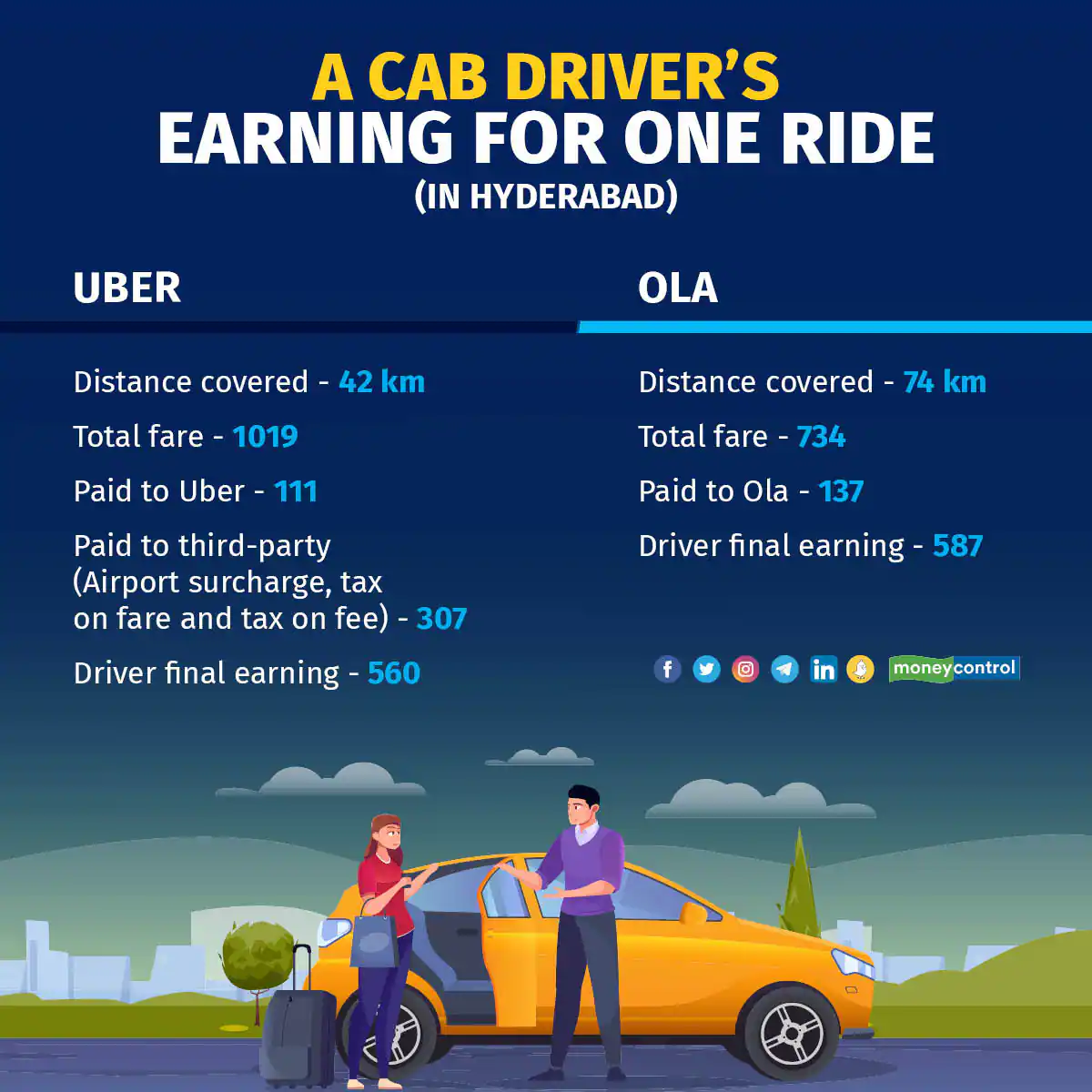
Several drivers told Moneycontrol that the rise in commissions to 20-30 percent of the fare and the increase in fuel costs.
>among other expenses, made it impossible to make do in the once-lucrative profession.
Drivers used to make up to Rs 1 lakh a month before 2017. Now, the very incentives that made driving for ride-hailing companies so attractive are pretty much non-existent, drivers said.
These substitute measures have become a requirement for drivers.
The gig economy started off as a way of giving workers the freedom to choose their hours and the type of work they wanted to do.
The ride-hailing apps were able to attract a large number of people, giving them a strong base of drivers to cater to customers in a short time.
However, having only one source of income was a body blow for drivers in terms of earnings and livelihood.
Ramesh is sometimes called by a tech company to drop employees.
He logs off the app and takes up that gig. With extra gigs, he makes Rs 30,000-35,000 a month, he said.
Another fairly common practice before the pandemic was for people to buy several cars and lease them to drivers.
The drivers paid the owners a fixed amount or a percentage of earnings, a model that worked when ride-hailing promised lucrative earnings. Amit, one such driver in New Delhi, has now taken on other jobs to sustain himself because these cars simply aren’t available anymore. “People who had 5-6 cars sold them. Many people’s cars were seized by banks for not being able to pay the EMI. Several people who used to work as drivers in such set-ups have taken on call centre jobs or other delivery jobs. I do food delivery on the side as well. If I get a car, then I drive. I used to split my earnings 50:50 with the owner after expenses, but there was no work after one point,” Amit said. Amit said people leave if they can’t make Rs 20,000-25,000 a month after expenses. “Even if you become a driver for a family, you will earn Rs 20,000. On the other hand, if it’s your vehicle, you put CNG in it, you drive for 14 hours and even then you hardly make Rs 15,000, then what is the point? People who are not very pressed for money are continuing to drive,” he added. Several drivers are part of informal groups on WhatsApp or Telegram where information on smaller jobs is available – like working for a family or quick outstation trips – and they can make some additional income without having to wait for the next ride. Other avenues The need for assured rides or stability in earnings has pushed many drivers to cab companies such as Meru. According to Kannan Chakravarthy, CEO of Meru Cabs, the post-Covid market now has a lack of experienced drivers as most of them have switched professions. “As a result, vehicle quality has gone down and subsequently, the type of drivers has also gone down,” he said, stressing that customers are now focussing on safety. City-to-airport travel has increased four-fold, he said, especially in Bengaluru and Hyderabad. From a driver perspective, Chakravarthy said most drivers on the platform are over 35 and “prefer constancy over high risk.” He said driver stickiness to the platform is about 80 percent, with the others switching between apps and gigs. Driver earnings have recovered to 80-85 percent of pre-Covid levels. The company even expects profitability at the operating level by the end of the year. Drivers who move around, depending on the earning potential of a gig, have been taking on work in other verticals as well. B2B gig marketplace Taskmo cofounder Prashant Janadri said several of these drivers are graduates or are tech-savvy to a certain extent and they are placed in other delivery fields and even as sales executives. Janadri said most people on Taskmo looking for gigs are not on the app for their primary source of income. “We have seen people from the auto/cab/taxi driver kind of segment work for some time in a day, but we are not their primary income source,” he said. However, he pointed out that the staffing requirements of ride-hailing companies have soared. Janadri said prior to the lockdown, companies required 5,000-10,000 drivers. In the past year, this number has shot up to over 100,000, he said, with Taskmo even re-onboarding drivers who left the platforms. Pravin Agarwala, founder of blue-collar staffing and HRMS company BetterPlace, said demand for drivers from IT companies hasn’t picked up and is nowhere near pre-Covid levels. In terms of demand, Agarwala said transportation is one sector that is yet to recover for blue-collar workers, whereas logistics, e-commerce, retail and BFSI have all seen a surge in demand. Elusive profitability Companies have steadily increased commissions collected from divers amid a fall in revenue due to the pandemic, but ride-hailing has so far proved to be unsustainable as a business. In 2020, Uber’s delivery was larger than its ride-hailing division, based on adjusted net revenue. In its results announced in May 2022, Uber’s delivery business continued to hold up with $2.5 billion in revenue reported from mobility as well as delivery. Last month, Bloomberg reported that Uber explored the sale of its India ride-hailing arm, which CEO Dara Khosrowshahi has vehemently denied. Uber’s primary India competitor Ola incurred a loss of Rs 328 crore from the ride-hailing business in FY21. It burned its hands aiming to get a piece of the delivery pie and has so far shut down quick commerce business Ola Dash, cloud kitchen business Ola Foods, and previous food delivery attempts with Ola Cafes and Foodpanda. It also shut down its cars business and has said it’ll be focussing on the electric division and increase investments in electric cars, cell manufacturing and financial services. Queries to Uber and Ola went unanswered. CIS researcher Rathi said an immediate solution would be for companies to revamp their rate cards by reducing commissions and penalties. “The rise in consumer and driver grievances has showcased the inherent unsustainability of the gig economy model itself. None of these issues crop up in a situation where drivers are hired – not temporarily contracted – are supplied with cars and have social security entitlement to soften the blow of economic upheavals,” he said. It appears to be a lose-lose game, with companies incurring losses on these divisions while drivers barely make enough to scrape by. Full circle Ride-hailing was once seen as a way for drivers to make more money and get greater freedom. Now, they are coming together to try and form unions and demand that governments ensure social security for them. “A majority of the work that you see on Indian platforms is actually employment being masqueraded as some kind of freelance work in order to circumvent basic labour protection like social security benefits or monthly minimum wage and things like that,” said Rikta Krishnaswamy, coordinator of the All India Gig Workers Union in the National Capital Region. There have been attempts at this, with the yet-to-be-implemented Code on Social Security seeking to offer protection to gig workers. In September, IFAT filed a public interest litigation in the Supreme Court contending that the failure to register gig workers as unorganised workers and provide them social security was a violation under Article 21 of the Constitution. “We’ve come full circle almost in a period of 10-15 years,” said Krishnaswamy, where the rhetoric has changed from saying that people will make a lot of money, which isn’t necessarily true. “The demand has gone beyond basic asks such as regulation of the company and has reached the level of asking the state to create alternative gig infrastructure,” she said. HARIPRIYA SURESH TAGS: #Blue collar jobs #Gig economy #mobile car-ride hailing #Ola #Ola Uber #Ride-sharing #Uber FIRST PUBLISHED: JUL 14, 2022 08:02 AM India Citizens could have extra income by using this opportunity. There are really common and easy ways to earn extra money for India Citizens. Read more. SurveyMonthly | Sponsored Canada is looking for skilled workers like you! ImmigCanada | Sponsored AI Program with 8000+ Career Transitions. Upskill Now World-Class Faculty | Dual Certificates | 8000+ Career Transitions | Dedicated Career Support Great Learning | Sponsored Every Indian Should Get This Incredible Rs.2499 Smartwatch BlazeFit | Sponsored Invest in Corporate Bonds with GoldenPi Get Higher Returns up to 13% compared to a FD of 5.4% GoldenPi | Sponsored Invest In Bonds for Consistent Returns At All Times No Brokerage, No Commission, Safe Bond Investment Made Easy GoldenPi | Sponsored Born between 1956 to 1996? You can earn a potential second income with companies like Amazon CFDs! Capitalix | Sponsored This Desktop App Helps You Write More Effectively Grammarly for Windows and Mac provides instant suggestions to make your writing clear and compelling. It works across the apps and sites where you do your most important writing: Slack, Word, LinkedIn, and beyond. Install it now! Grammarly | Sponsored WATCH MUST LISTEN The Week on Dalal Street | Market trend reverses, PSU stocks may underperform The Week on Dalal Street | Market trend reverses, PSU stocks may underperform DAILY-WEEKDAYS ESSENTIAL STORIES & INSIGHTS FROM THE STARTUP & TECH WORLD IN YOUR INBOX Your Email ID SUBSCRIBE Sponsored Links You May Like Canada is looking for skilled workers like you! ImmigCanada AI Program with 8000+ Career Transitions. Upskill Now Great Learning Every Indian Should Get This Incredible Rs.2499 Smartwatch BlazeFit Invest in Corporate Bonds with GoldenPi GoldenPi by Taboola
This is about the current news of online cabs in india